
Key Takeaway
Tiny home solar panels can power a small dwelling, but the right system size depends on your daily energy load, site sun exposure, available mounting space, and whether you connect to the grid or go fully off grid. A standard 400W panel produces roughly 1-2 kWh per day depending on location. Before counting panels, complete an appliance-by-appliance load calculation and run your site through NREL’s PVWatts Calculator to get real production numbers.
Yes, solar panels can power a tiny home. The right solar system, though, depends on how much electricity the home actually uses, how much sun exposure your site gets, how much usable mounting space exists, and whether the tiny home stays tied to the power grid or runs off grid. Square footage tells you almost nothing about your energy needs. If you’re planning a tiny home or compact dwelling and you’re worried about cost surprises or whether solar will even work on your property, this guide walks through what has to be settled first, before anyone starts counting panels.
Can Solar Panels Power a Tiny Home? Renewable Energy Basics
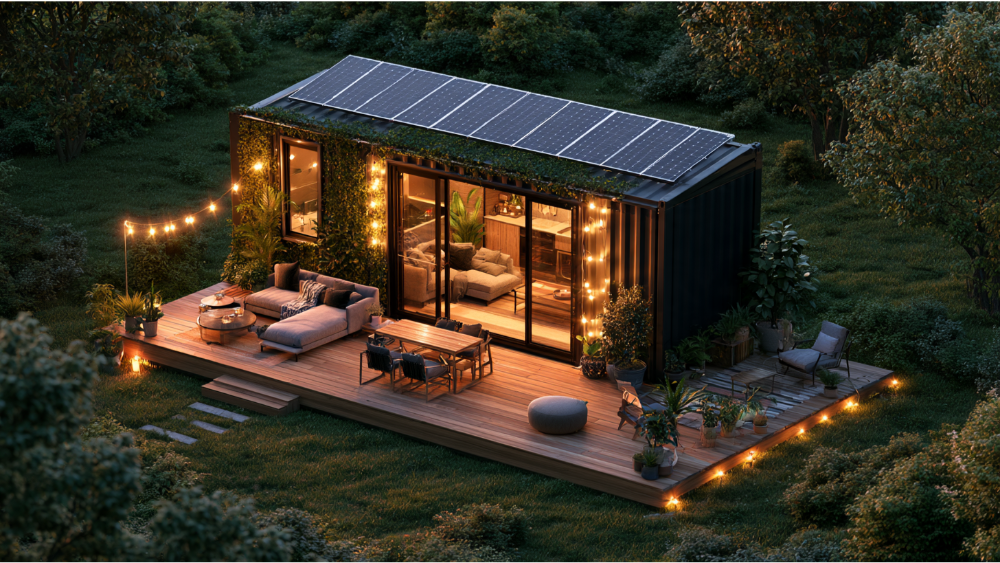
They can, and a small home is a favorable place to start because there’s less electrical load to cover. Two ideas carry the rest of this article. First, power and energy are different: a kilowatt (kW) measures instantaneous power, and 1 kW equals 1,000 watts, while a kilowatt-hour (kWh) measures energy used or stored, equal to 1 kW running for one hour (DOE glossary). Solar panels and inverters carry power ratings. Consumption and batteries are measured in energy. Second, solar solutions exist on a spectrum: grid-tied, hybrid, and off grid, each solving a different problem. Solar panels by themselves aren’t a system, and the technology only delivers when the panels, inverter, batteries, and wiring are designed as one.
What Kind of Tiny Home Are You Building?
The 2021 International Residential Code’s Appendix AQ defines a tiny house as a dwelling unit of 400 square feet or less, excluding lofts, but that’s a model-code provision, and your locally adopted code controls (ICC). A permanent tiny home on a foundation, a manufactured or modular unit, and a tiny house on wheels follow different approval paths and different structural and weight limits. That classification shapes whether roof-mounted, ground-mounted, or portable tiny home solar makes sense. Confirm your classification with your local building department early.
How Much Electricity Does a Tiny Home Use? Sizing to Your Energy Needs
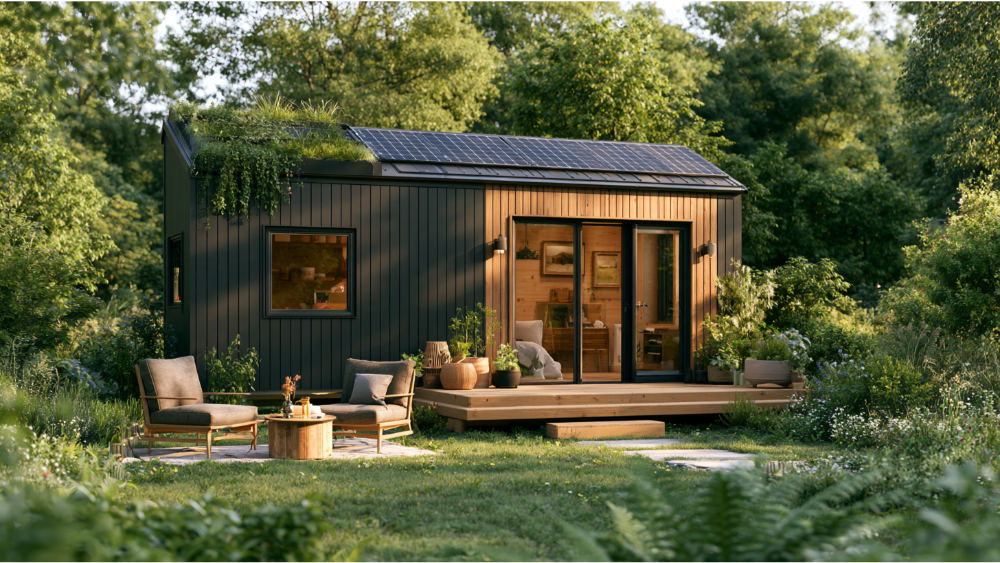
This is where real sizing begins. The Department of Energy’s approach for a home without utility history is an appliance-by-appliance load schedule, and it’s the only honest way to pin down your energy needs.
Daily watt-hours = appliance wattage × hours used per day. Add every appliance, then divide the total by 1,000 for kWh.
Sort your electricity loads into categories:
- Continuous: refrigerator, controls, network equipment
- Daily: lights, laptops, water pump, phone charging
- Short high-power: induction cooktop, kettle, microwave, well pump start-up
- Seasonal: mini-split heating and cooling
- Future: EV charging, added appliances, a second occupant
We won’t publish a “typical tiny home uses X kWh per day” figure, because appliance and climate choices swing that number wildly. For contrast only: the EIA reports the average U.S. residential customer used 865 kWh per month in 2024, which says nothing useful about your build. All-electric heating, cooking, and water heating usually dominate solar system size.
Grid-Tied vs. Hybrid vs. Off Grid Solar: How You Relate to the Power Grid
Your utility situation drives this choice more than anything else. One point worth stating plainly: ordinary grid-tied solar shuts down during a utility outage for safety (DOE). Outage performance requires storage plus an islanding-capable inverter. And off grid systems have to be sized against monthly and seasonal production, not annual averages, because a solar array that balances on paper over twelve months can still run short in December.
Off Grid Living: What Complete Independence Requires
Off grid living means no meter, no interconnection, and no safety net. Everything the tiny home consumes has to come from the panels and the battery bank, sized around the worst solar month rather than the best. Many owners chasing complete independence also keep a propane or generator backup for long stretches of weather, which isn’t a failure of the design, it’s the design. Off grid living rewards small, efficient loads and disciplined habits, and it asks more of the electrical design than any grid-connected setup.
| Grid-Tied | Hybrid | Off Grid | |
|---|---|---|---|
| Utility connection | Yes | Yes | None |
| Battery required? | Optional | Yes | Yes |
| During an outage | Shuts down | Supports selected circuits | Unaffected by the power grid |
| Sizing objective | Offset annual usage | Offset usage plus backup | Meet worst-month demand |
| Approval path | Permit plus interconnection | Permit plus interconnection | Permit, no interconnection |
| Best suited for | Utility-served sites | Owners wanting backup power | Remote sites with no service |
How Many Solar Panels Does a Tiny House Need?
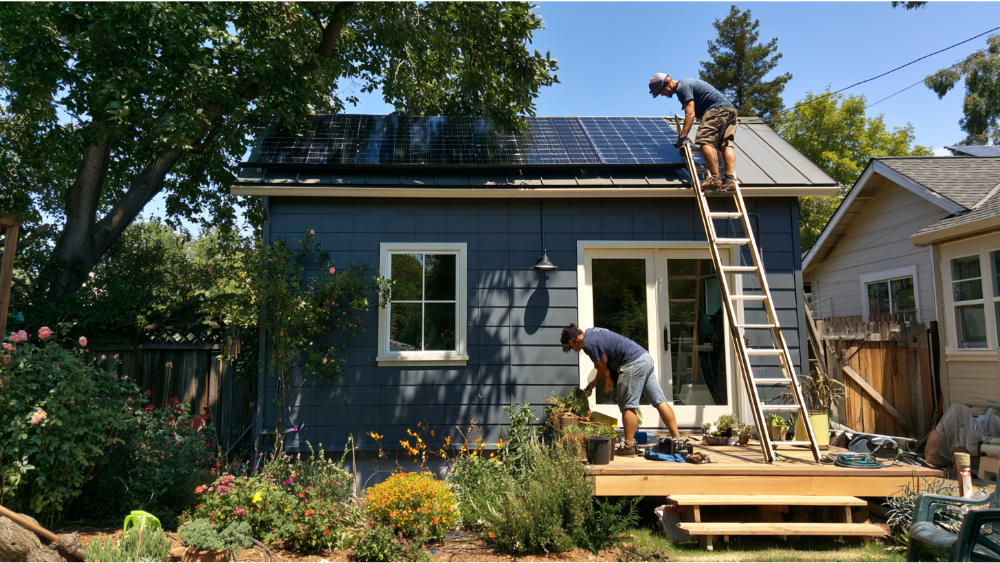
Skip the “four to ten panels” shortcut. It’s a guess dressed up as a spec. Here’s the process that actually produces a defensible number:
- Finish the load calculation above and land on a daily kWh target.
- Run your site and a preliminary array through NREL’s PVWatts Calculator for location-specific production. NREL models roughly 14% default system losses as a modeling assumption, not a promised real-world figure.
- Review month-by-month output, not just the annual total.
- Pick a representative solar panel wattage. DOE’s 2025 residential benchmark uses 400 W modules at 20.4% efficiency, a benchmark configuration, not a universal spec.
- Divide: panel count = target DC array watts ÷ panel watts, rounded up.
High-efficiency monocrystalline modules help most when mounting space is limited. Treat every number you get this way as preliminary until a designer confirms the actual layout.
Will the Solar Panels Fit? Roof Space vs. a Ground Mounted Solar Array
Total roof area and usable roof space are rarely the same. Vents, skylights, mechanical penetrations, ridges, required clearances, fire-access pathways, and shade from trees or a neighboring roof all subtract from what you can actually cover. DOE notes that solar panels typically perform best on unshaded, south-facing roofs sloped between 15 and 40 degrees, though other orientations can still work well.
Then there’s load. The roof and racking have to carry the array and handle local wind, snow, and hail exposure, and units built on wheels have hard weight limits that push owners toward lighter flexible modules. For a compact footprint, a ground mounted solar array is often the better answer: more space, and you can angle it for better sun exposure instead of fighting the roof.
Batteries, Inverters, and Backup Power: Building Energy Independence
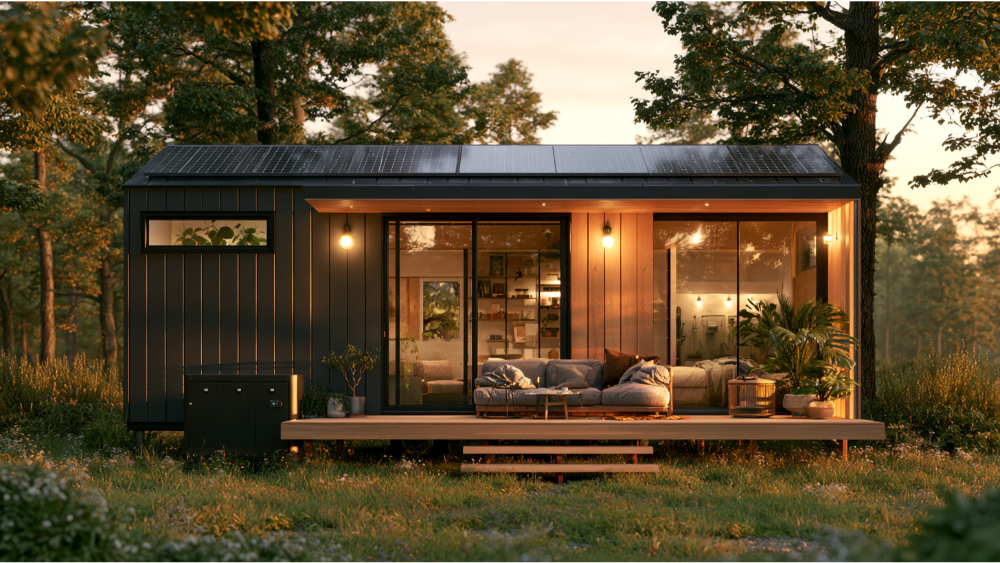
Battery energy capacity (kWh) determines how long your loads run. Battery and inverter power rating (kW) determines how many loads run at once and whether motor start-up surges are covered. Those are separate problems. A battery bank can hold plenty of energy and still be unable to start a mini-split and an induction cooktop at the same time.
Decide which circuits matter during an outage, how many cloudy days of energy independence you want, and where the batteries and electrical equipment physically live. Lithium iron phosphate chemistry is common in small homes partly for its weight. DC routing and safe equipment housing are design decisions, not afterthoughts, and battery placement often drives interior space planning more than tiny homeowners expect.
Design Choices That Shrink the Solar System You Need
Every watt you remove from the load is a watt of energy you never have to generate or store. A high-performance envelope with good insulation and efficient windows. Right-sized heat-pump heating and cooling. ENERGY STAR appliances, LED lighting, heat-pump water heating where it suits the project, and simple load scheduling so the big electricity draws don’t stack. Fuel and appliance choices are project-specific tradeoffs, not universal advice. All of it belongs in the design phase, next to roof geometry and electrical capacity.
Permits, Code, and Utility Approval for Tiny Home Solar
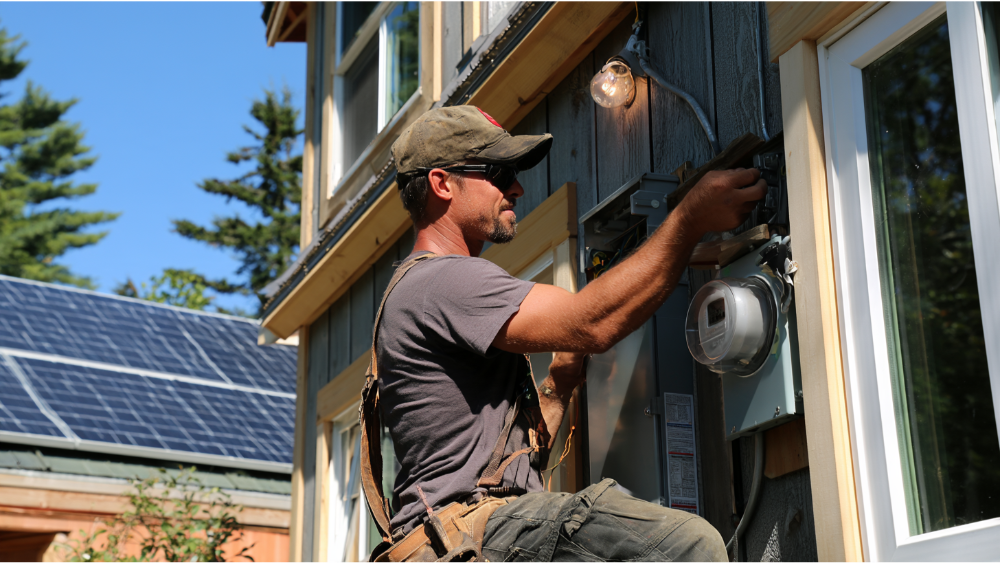
Local governments generally require a permit for rooftop solar, the finished system gets inspected, and a grid-connected project must complete utility interconnection before receiving permission to operate (DOE). Physical installation often takes a few days, while permitting and inspection can run weeks to months depending on the jurisdiction. Net metering availability and credit structure vary by state and utility, as do battery placement and fire-safety rules. Look for equipment listed to applicable standards (UL 61730 for modules, UL 1741 for inverters, UL 9540, UL 9540A, and UL 1973 for storage) and accepted by your local authority having jurisdiction, insurance company, and utility.
What Does Tiny Home Solar Power Cost?
Small systems don’t scale down proportionally. Design, permitting, electrical work, mobilization, and inspection cost roughly the same whether the array is 2 kW or 8 kW, so generic cost-per-watt math tends to understate small projects. Published third-party estimates put a 1 kW system near $3,250 and a 3 kW system near $9,750 before incentives, with annual savings often cited around $250 to $750. Treat those as illustrative outside estimates only. Real pricing moves with site conditions, equipment, and your local labor market.
Separate cost drivers worth pricing individually: solar panels, racking, inverter, wiring and disconnects, any electrical service upgrades, permitting, storage, installation labor, and design.
On incentives: the federal Residential Clean Energy Credit equaled 30% of qualified costs for property installed through December 31, 2025, and per the IRS it is not available for qualifying residential expenditures made or property placed in service after that date. Check current state, local, and utility clean energy programs, and talk to a qualified tax professional about your situation.
How Long Do Solar Panels Last, and What Maintenance Is Involved?
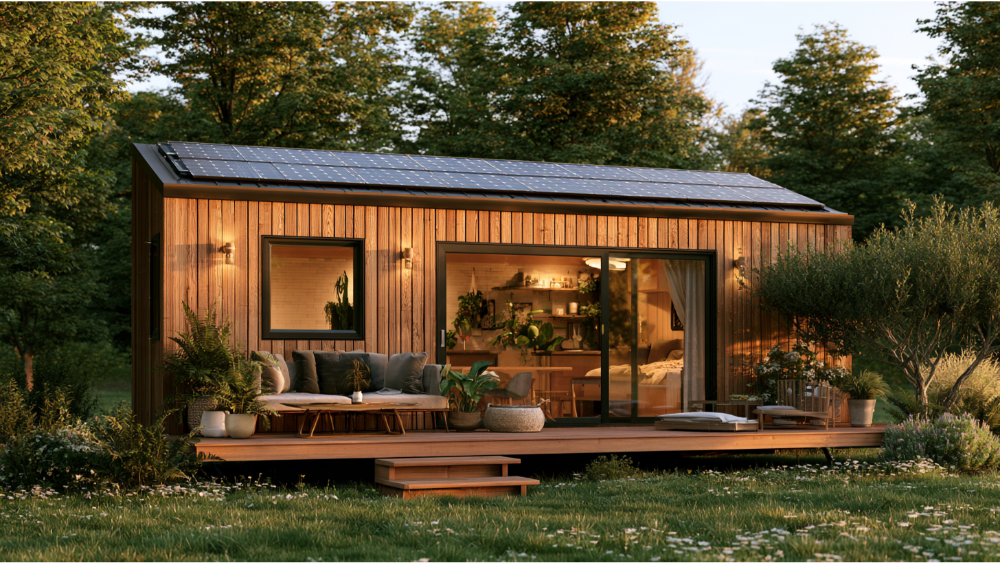
DOE estimates current solar panels have an average operational life of about 25 to 35 years, with module performance degrading roughly 0.5% per year. String inverters commonly last 10 to 15 years and may need replacement within the panels’ useful life. Batteries follow their own replacement cycle, so ask about expected battery bank life before you sign anything. Plan for monitoring, keep your warranty documentation, and make sure there’s safe roof access for cleaning and repairs. Leave room for future panels, added storage, or new loads. Once running, the system produces clean energy with no direct emissions.
Your Tiny Home Solar Planning Checklist
- Site address and lot orientation
- Permanent or movable classification
- Whether utility service is available at the site
- Number of occupants and expected use pattern
- Appliance list with wattages
- Heating and cooling plan
- Water-heating and cooking choices
- Estimated daily kWh
- Desired backup duration and battery bank size
- Preliminary roof plan or elevations
- Shade and sun exposure notes
- Local building department and utility contacts
Frequently Asked Questions
How many solar panels are needed to power a tiny house?
There’s no universal number. Derive it from your daily kWh load, location-specific production from NREL PVWatts, and your usable mounting space, then divide: target DC array watts ÷ panel watts, rounded up.
Can you power a tiny house with solar panels?
Yes, with correct sizing. A grid-tied home can run without storage, while an off grid home also needs properly sized batteries, enough inverter output, and often a secondary source for extended poor weather.
Will a 400W solar panel run a refrigerator?
A single panel doesn’t “run” an appliance. Production varies with sun hours, and the refrigerator draws electricity all night, so compare the fridge’s daily watt-hours against the panel’s daily output and confirm the battery and inverter can carry it after dark.
What is the best solar system for a tiny house?
It depends on grid access and outage expectations. Grid-tied suits utility-served sites, hybrid adds backup for selected circuits, and off grid is the answer where no service exists.
Is off grid living realistic for tiny homeowners?
It is, when the loads are modest and the battery bank is sized for the worst solar month. Homeowners who choose all-electric heating and cooking should expect a larger, more expensive system, or plan on a backup source for the darkest weeks of the year.
Plan Your Tiny Home to Be Solar-Ready From Day One
A solar-ready home is designed as one complete system: roof orientation and structure, electrical capacity, conduit pathways, equipment locations, and space to expand, all decided during design rather than retrofitted later. That’s exactly what our in-house model is built for. Architectural design, structural and civil engineering, permitting, and construction live under one roof, so you’re never coordinating three firms.
Start with a 1-hour initial project walkthrough. You’ll get honest site feasibility insight, design guidance on your Accessory Dwelling Unit (ADU) or tiny home, and a clear path from concept to completion. Let’s connect: call (916) 909-2387 or email office@gsadus.com to book a consultation.